

What was once a daily needed skill has been relegated to art or hobby in many first and second world countries.
Working with different fibers using our hands and some basic tools has been a survival skill of humans, almost since day one. Joseph’s family kept sheep and he had a woven tunic of many colors. That is sheep to shawl 3,500 years ago!
The Industrial Revolution caused the loss of many jobs for those who stayed at home and spun, knit, crocheted or made lace and other items to support the family financially. These people were the elderly, mothers of young children and others who weren’t able to work outside of the home. This also caused loss of community as quilting for example is now being done by machines and people no longer gathered to quilt.
Stitching together as part of a daily routine helped people to be connected to one another, give opportunity for education, both in stitching and life and worked as a support system within a village or town.
These people lost their means of making an income when the machines replaced the work they were doing by hand. If they chose to go work the machine, there was something sacrificed to do that. Time with others especially. Some didn’t have working the machine as an option due to the reason they couldn’t work outside of the home to begin with; caring for others, being elderly… This meant the loss of the income altogether for that household.
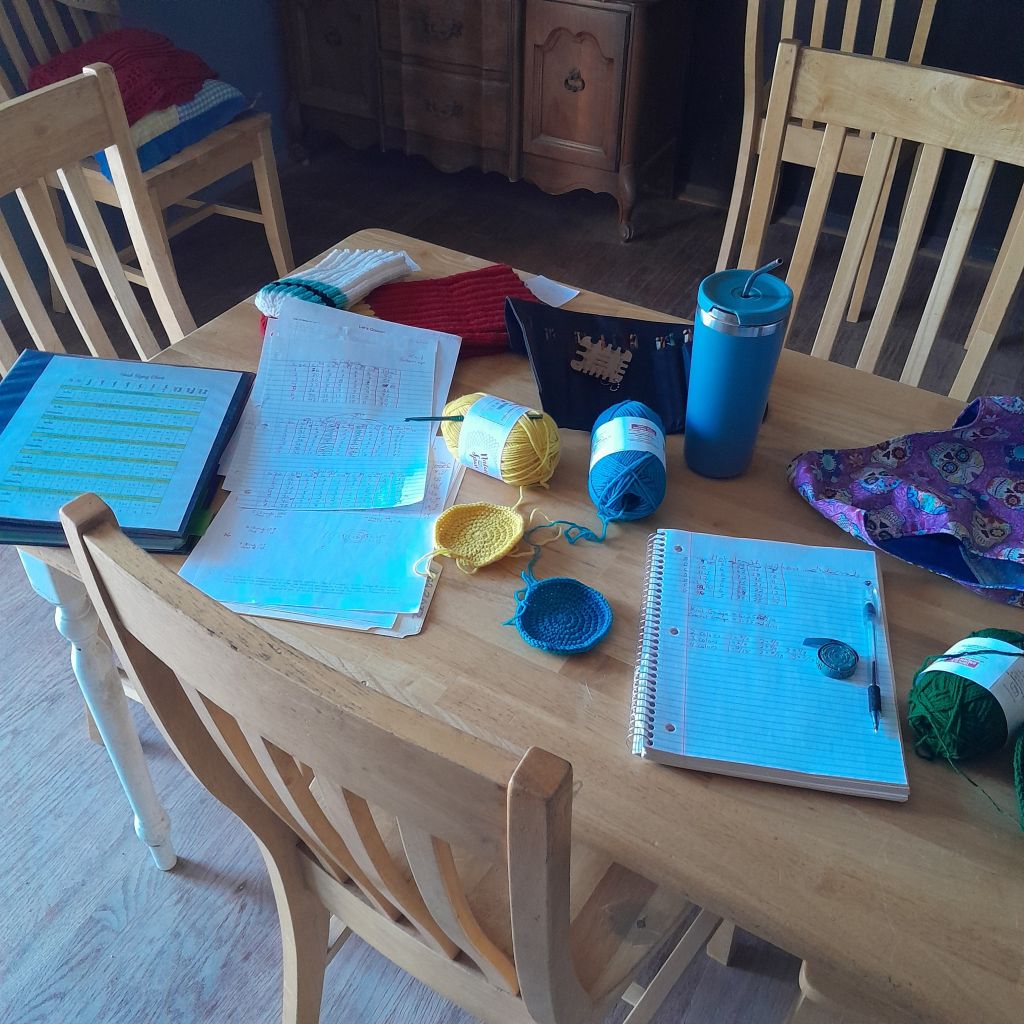
As we have moved into the 21st century and the boom of tech revolution, I am seeing more loss for all type of artists and the fiber arts is being hit hard again. Pattern designers are in competition with patterns made by AI. While most of the patterns generated by AI don’t match the photos generated to go with it and the instructions have holes, that hasn’t stopped people from purchasing those patterns, usually at a low cost.
This has impacted designers in multiple ways; the income they can expect from a completed pattern, the expectations stitchers have on designers and facing that choices of how to deal with all of this. Let’s break these down one at a time.
The amount of time, work and collaboration that go into making a clear, usable crochet or knit pattern is something that many stitchers don’t understand, unless they have tried to design something themselves and write it down. Read THIS post to learn more. All of this costs money and the idea is to make the money back from pattern sales and possibly some income from content generated for the pattern such as YouTube videos or blog posts.
Due to ALL the information being available and user friendly, right NOW, the way the younger generations are learning has shifted. They take being a visual learner to the extreme. I know some stitchers in this age group who don’t use written patterns at all but watch a stitch-by-stitch video of how to make something. If a designer wants to put out the resources to make a stitch-by-stitch video of their design, that is their decision. Is does have an impact on the industry though when so many designers do things like this that stitchers begin to complain that other designs aren’t “accessible” to them. For real? No. Those stitchers are making the decision to be tech dependent and refusing to learn a new skill. Some of the things that stitchers are complaining of are ridiculous and some of the things that designers are doing are enabling stitchers to remain uneducated and stuck.
That brings me to my final point in this section and that is all the extra decision designers now have to make aside from font choice and layout flow. How “accessible” am I going to make my pattern for this design be? I understand accessibility to a point. My daughter is hard of hearing and things like subtitles are very helpful to her. I appreciate the things that tech has made available to me as a designer and the many ways I can share my pattern.
As a designer I have chosen to make crochet and knit patterns that are written using a sans serif font for clarity. I also list the skills needed on the front page and in the description of each pattern so the stitcher knows what they are getting into. I fully support each pattern from 2024 forward with links to tutorial videos for most, if not all, of the skills used in the pattern. There videos are to the point, close up and subtitled. Many include “Stitch with Me” instructions so that the stitch can try it out while learning from the tutorial. I have covered all the major learning styles. I am also available through email, Ravelry messages and comments on posts for any assistance a stitcher would like to ask for. I have been know to walk someone through a tricky spot on the phone even. I will not however be making stitch-by-stitch videos of any of my patterns not will I dumb down my use of abbreviations for those who are refusing to learn to read the language of crochet and knit.
As if there weren’t enough loss of physical community after the Industrial Revolution, there has been even more now that we can connect over the internet. Yes, being able to see what crocheters in a country 6 time zones away are making is amazing to me, but what the crocheter 6 doors down? Oh, you didn’t know they crochet…
I know for me personally, if hadn’t had my local crochet and knit community group I would never have learned as much as I have and enjoyed stitching as much as I do. I can say that with full confidence as I now live somewhere that doesn’t have that kind of group. I feel like I’m stitching in a vacuum and it has less meaning, same purpose, but less meaning and some days are a struggle to continue the work.
I do have an online community that is absolutely essential to the work I do. Outside of that community I don’t know anyone IRL who is a tech editor.
Social media of course has had both positive and negative affects on the fiber arts industry. It has made some things more available to people, verses mail order catalogues for example, while it has given stitchers false ideas of what a fiber life style is or how much ripping goes on behind the scenes. As with anything on social media, remember it isn’t the whole story.
The last thing I’m going to touch on is fresh for many in the fiber world right now. That is ecommerce is taking over LYS. Recently some large yarn companies have been acquired by a parent company that doesn’t do wholesale to LYS. They only sell to the individuals on the internet. Big business has already taken over so many other family run industries, restaurants, food, clothing… We need to buck the system here and not let them take this as well. With the tariffs coming into play, there will have to be more work done here in the US, which I am thankful for. Start supporting you neighbors now. Shop local whenever possible and buy US made when possible. HERE is a link to a spread I have where to get US wool products. There is more made in your backyard than you think. You just have to look a little harder and possibly pay a little more, but not always. It is often better quality and you will have more satisfaction from the purchase because you know a little something about the people behind the company you’re purchasing from.
I’m sorry if this post has an edge to it. Stitchers, designers, tech editors, it’s time to step up and step in so that we don’t lose the great industry we have. Encourage other stitchers to educate themselves. Educate others, become educated yourself. After all what good is the skill of following a stitch-by-stitch crochet/knit video if the grid has gone down or the zombies have come?
Happy Making!
 Azariahs Fibre Arts
cool!
LikeLike