
While stitching has many health benefits, it can be hard on our bodies if we aren’t intentional and careful. I know many of you have probably heard this before, but are you listening? Have you applied what you’ve heard?
In this convenient, everything-at-your-fingertips-on-your-phone world, it has become all too easy to sit in one place for a long time. Sometimes for a very long time. TV streaming services, on your TV or phone propped up next to you means that you no long have to switch disks if you’re binge watching a show. This is often without commercials, so no incentive to get up there. I remember as a kid and teen, then even into adulthood, seeing what I could get accomplished in a commercial break. There aren’t any “games” like that now. How easy is it to sit for 3, 4 or even 6 hours at a time, and probably not even realize it. Your body feels it though and over time, too many times of sitting like that can cause irreversible damage.
Instead don’t sit for more than two episodes of longer shows such as Smallville or Supernatural; or four of shorter shows such as Fresh Prince or Roseanne. If the app you’re watching from, or your TV, asks if you’re still watching, it’s time to get up and move. Now we have pause buttons and can even “rewind” live TV. You don’t have to miss anything.
Remember to drink enough, this also makes it necessary to get up. Don’t drink only things that are going to dehydrate you though. Make every other glass or cup be water.
Your choice of chair and how you’re sitting in the chair matters as well. My grandmother owned and sat in a recliner until the day she went to the hospital where she passed. She was 82 when she passed and still sitting in a recliner with her legs tucked under her. She experienced little back problems in life and stood straight up with no hunching until the end.
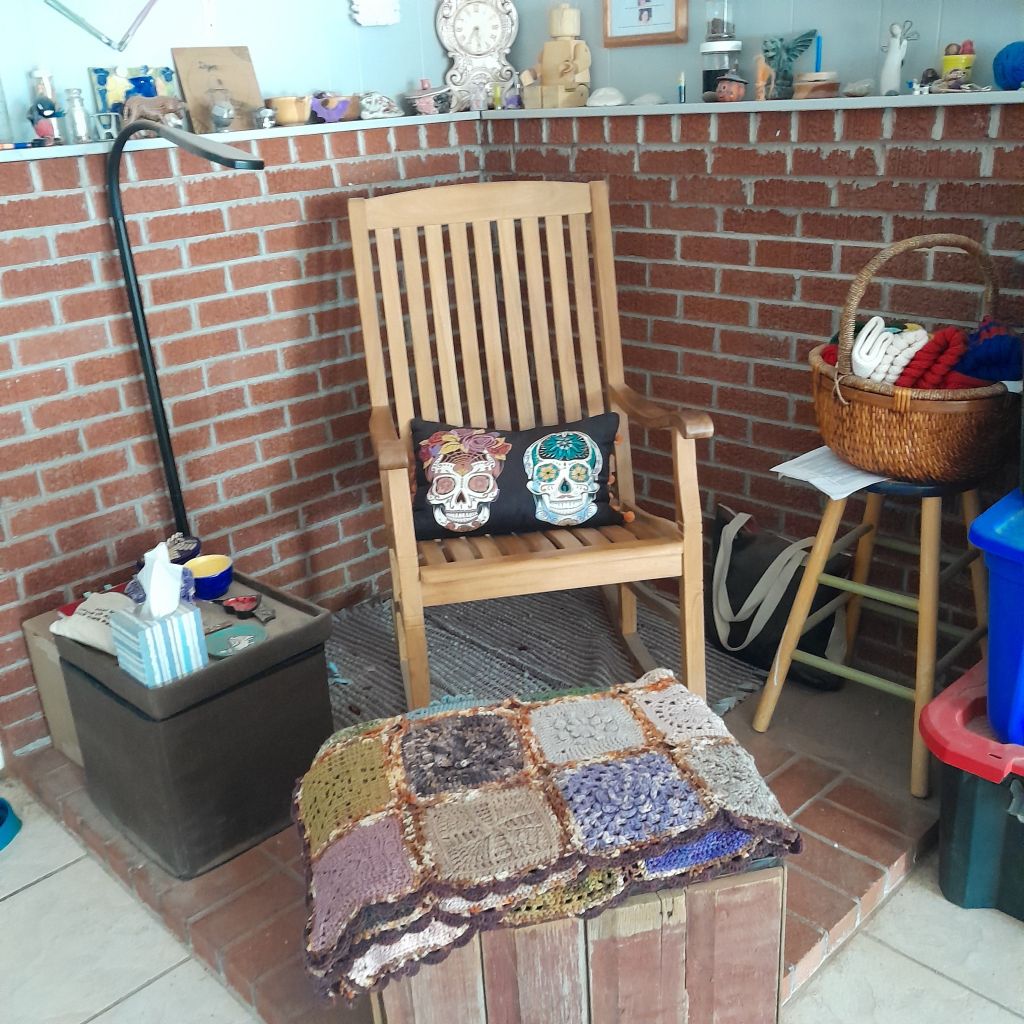
This is not to say that a recliner is the way to go. No, this is more about knowing your body and what works for it. We are not one-size-fits-all. I have 3 of the same rocking chairs in different locations in my house because they are what work best for me. The dining room chairs are wood with no cushion. again for me. I do have back issues and have since middle school. These chairs help me to care for my back with the support they offer.
Your position in the chair needs to be a mindful one with things in reach and an easy view of what it is you want to look at; the TV, the window or children playing nearby. Sitting straight up is good for your bones and muscles and it helps you to breathe deeply keeping you alert and better focused.
Crossing your legs can help prevent swelling, as can the use of an ottoman or footstool. Be careful with those, that can push parts of your lower back out of alignment and causes more issues than the swelling.
If you are a monogamous stitcher, may I recommend that you add just one more project? Chances are the one project that you have going isn’t mindless stitching. Sometimes it is but if you are growing as a stitcher it won’t be. Those type of projects take a different level of mental focus but they also require more from your body than the mindless stitching does. Have one project that is more difficult and requires more of you and have another that requires very little of you. Something that you can stitch and not look at the entire time. A garter stitch scarf, a single large granny square blanket… I have a lace project that I work on no more than twice a day, for no more than 45 minutes in each session. Yarn overs, nupps, decreases and reading the chart, it is mental and physical. I keep a simple ribbed baby hat going for church, dinner out or other similar situations. For evening stitching while spending time with my husband, either in front of the TV or outside on the bench I have currently have a crocheted beanie that is all half double crochets.


Having a project that is more mindless stitching or has sections of mindless stitching in it can help you to care for you eyes and neck.
If you find yourself squinting, it’s time to change something. Maybe it is as simple as turning on a light or getting more light. I have a neck light that I use, it has three light settings. I use it when watching movies with others at home, not at the movie theater that didn’t work, or if I go outside in the evening to stitch but it’s already dark. Do a search for “neck light” and you will have many options to choose from. There are some situations where I am working a stitch or color and I just need more light, this works great for that. If you are finding that you need more light or want a personal light source, I recommend Ottlites. I have had an Ottlite of some sort near at least one of my stitching chairs since I got married. I recently replaced my ancient one with a newer model and it is brighter and quieter too.

Squinting could also be from eye fatigue. Time for a break. If you are working with fine yarn, fingering weight or less, it might be time for a project change as well to something with heavier yarn. Another project in the bag!
A project with sections of mindless stitching means that you can look away from it and keep stitching. This will take some practice and probably some ripping but is so worth the effort to learn. It also gets great reactions in public, some are impressed and other are freaked out by it. Either way it means you get to keep stitching.
Being able to look away exercises your eyes to focus on things at different distances in the room. It also means that your neck isn’t stuck bent down for an entire stitching session. You can look around the room, up, down and exercise the muscles in your neck so that you aren’t stiff and in pain later.
Our hands and by extension our arms are often affected the most by our stitching. Spending a lot of time in the same, or a similar, position and doing a repetitive motion again and again for an hour or two can be really taxing. Stop and take a break, even just with your hands about every 20 minutes or so. If your rows or rounds are really long, I have a project with 603 stitches to a row currently, take a break after a round or two. If they are shorter then take a break every 10 or 20 rounds. You don’t have to be exact about it, but if you missed it, stop when you realize and rest those fingers. Try some simple stretches for fingers, wrists and elbows. Roll your shoulders. Then pick up your stitching again and carry on.
We Are Knitters Hand Stretches Blog Post
Lovecraft Hand Stretching Video
While our hands are what we use most for stitching, we need to care for our whole body to be able to continue stitching for as long as we’d like to.
Bottom line is know your body, know your limits, listen to your body and enjoy stitching responsibly.
Happy Making!
 Azariahs Fibre Arts